
Six Hours to Build a Casino That Floats
What our crew does between the last guest leaving and your first guest boarding: the load-in, the rigging and the thousand small checks you never see.
At midnight the last guests step off the gangway. By 06:00 the deck is a different room: felts changed, tables renumbered, a hundred chair positions measured to the centimetre. This is the part of the production nobody photographs, mostly because it happens while the city sleeps.
Here is the morning your event gets built, hour by hour.
Hour One: Striking the Deck
Everything from the previous event comes out first. Linen bags to laundry, props to storage, the previous client's branding off every surface. The crew works in silence partly because the terminal has neighbours and partly because tired guests leave belongings that need cataloguing before anything moves.
Lost property goes to the office safe with a note of the seat number. You would be surprised what the seats collect: cufflinks, reading glasses, three car keys and once a wedding ring that made it home by courier the same morning.
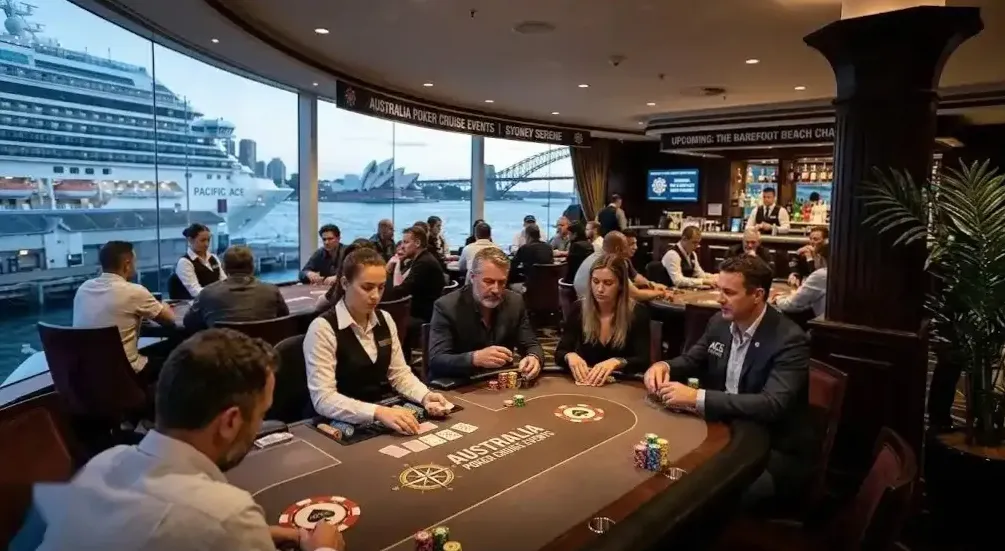
Hours Two to Four: The Gaming Floor
Gaming tables come out of their cradles and go down to the millimetre of the floor plan, because a roulette wheel out of true is a biased wheel. Felts are steamed, chips are counted into racks by the cage, and every deck of cards is a fresh sealed pack. Nothing from a previous night touches your game.
The dealers arrive at 15:00 for briefing: the client's name, the format, the tournament clock, and which guests need teaching. A dealer who knows the brief in advance is the difference between a night that runs and a night that merely happens.
Guests should never think about the work. The best compliment our crew gets is that the evening felt effortless.
Hour Five: Checks
The last hour before boarding is a checklist, not a hope. Sound levels are tested, the tournament clock runs a rehearsal, the bar is counted, and the floor plan gets a final walkthrough against the run-sheet.
Field Notes
- Table count and seat numbering verified against the guest manifest.
- Chip racks counted twice by two people; discrepancies get found before the event, not during.
- The PA, the screens and the clock all run a dry cycle.
- Emergency exits, gangway lighting and deck markings checked by the safety officer.
The Quiet Hour
Between checks and boarding there is a strange stillness. The deck is finished, the crew is in uniform, and the harbour does what it does. That hour is when the producers take their own walk-through, seeing the room the way your guests will, and fixing the last few things only a fresh eye catches: a wobbly table leg, a signage angle, a light that hits the felt wrong. Then the gangway opens and it all starts again. It is unglamorous work and none of it is visible, but it is also the reason the evening feels effortless when you are standing in the middle of it.
If You Only Remember Three Things
- A casino deck is rebuilt completely between events, not just cleaned.
- Fresh chips, sealed cards and measured tables are standard for every event.
- Dealer briefings happen hours before boarding, which is why the night feels smooth.
Renata Kowalski
Renata still walks the floor during load-in most event mornings. She insists the room has a mood before the first guest arrives.
Ready to Write Your Own Story?
Everything in this guide happens better on the water. Tell us about your event and a producer will map it inside one business day.